The Enterprise Agent Brief April 2026
Vectara's April 2026 Newsletter
5-minute read time

🛠️ Building Semiconductor Agents w/ Vectara 🛠️
 Play video
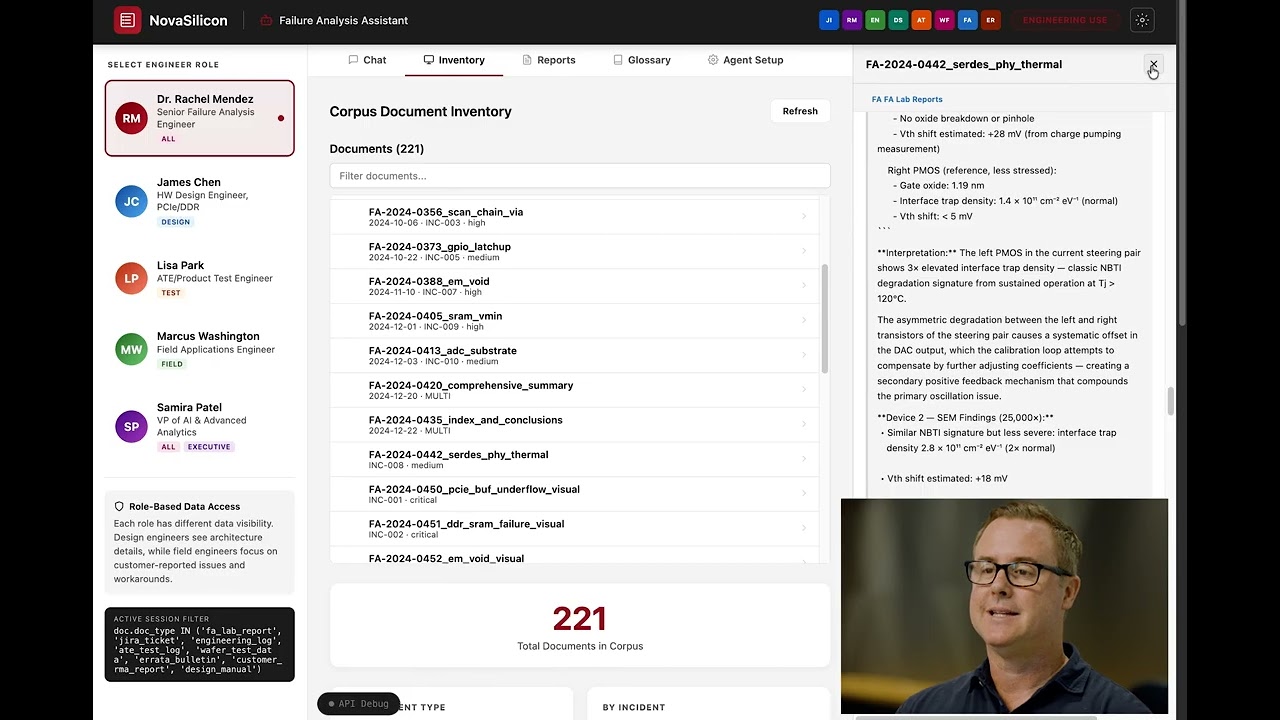
In our newest demo, Vectara’s Field CTO Jeff Chapman showcases how AI agents can transform semiconductor failure analysis workflows. The application demonstrates how engineers can quickly investigate chip performance issues by querying across a wide range of complex data sources, including ATE logs, RMA reports, engineering notebooks, and design specifications. By unifying these multimodal datasets and enabling natural, iterative questioning, Vectara helps teams move faster from initial alert to root cause understanding.
Beyond analysis, the demo highlights how AI agents can automatically generate detailed, specialized reports tailored to specific reports like grade binning and parameter qualification. For organizations dealing with high-volume, complex semiconductor data, this approach streamlines both investigation and documentation. If you're exploring how to build AI agents for failure analysis, reach out to learn more about how Vectara can help you get started.
🛡️ Responsible AI with Vectara and OPAQUE 🛡️

Tallat Shafaat, CEO of Vectara, and Aaron Fulkerson, CEO of OPAQUE held a live roundtable April 29th exploring what it truly takes to build and operate trusted and responsible AI systems in the enterprise.
As organizations rapidly deploy AI agents into production, new challenges emerge around data leakage, AI governance, model accuracy and hallucination mitigation, infrastructure isolation, and verifiable runtime protection. Their discussion examined how enterprises can safely operationalize AI agent platforms using Kubernetes-based containerized environments, while maintaining visibility, control, and compliance.
The conversation highlights the importance of secure-by-design agent building with Vectara, enabling grounded, reliable AI experiences, alongside OPAQUE Confidential AI’s provable privacy and guaranteed governance.
📄 AI Agents for Loan Generation 📄
 Play video
Commercial real estate lending runs on dense, fragmented documentation, from loan agreements to appraisals and credit memos. With AI agents, that complexity becomes an advantage instead of a bottleneck. Teams can now automatically generate detailed credit memos, extract key insights across multiple documents, and ask natural language questions with answers grounded in source data. Instead of manually piecing together information, lenders get a clear, structured view of every deal in seconds.
Just as powerful is the ability to compare documents at scale. AI agents can cross-check agreements, flag inconsistencies, and ensure alignment across versions, reducing risk and improving decision quality. This means faster underwriting, stronger compliance, and more confident approvals. If you’re ready to move beyond manual workflows and start building intelligent, document-aware systems, now is the time to get started.
👑 Context is King 👑

If you’ve been exploring AI agents, you’ve likely seen how easy it’s become to host one. But building a truly production-ready, scalable agentic system is a very different challenge. In our latest blog, we break down why hosting an agent is only the starting point, and why real value comes from designing a full agentic platform that handles orchestration, context, governance, and reliability from day one.
We dive into the critical role of context engineering, ensuring agents have the right information at the right time to reason, act, and deliver accurate outcomes. Read the full blog to learn how Vectara approaches agentic platforms differently, helping teams move beyond demos to production-grade systems with built-in scalability, grounded responses, and enterprise-ready controls.
🔋 Product Updates 🔋
Use agent connectors to chat with your agents in Slack
You can now configure an agent with a Slack connector, which will automatically enable you to chat with the agent in your Slack workspace.
Use glossaries to teach your agents about domain-specific terminology
With this new feature, you can define sets of terms and their definitions inside glossary objects, and then use glossary reminders to provide access to this information at specific moments. This improves agent performance when reasoning about domain-specific requests, while preserving context.
Context management: Consumption-reporting and compaction
Agents now report how much of their context window they consume over the course of a session. If a session nears context exhaustion, you can compact the session to recover the context. Compaction produces a summary of a session’s events so that the agent doesn’t need to populate with context with those original events, while retaining access to relevant information.
Context management: Tool output offloading
Tool calls can produce verbose output, which can inefficiently consume valuable context. When tool output offloading is enabled, these outputs are stored in artifacts instead. This enables the agent to intelligently and selectively access the tool output, using up context only when that information is needed.
Agent instructions support conditional logic and multi-step workflows
When configuring an agent in Console, you can enable the “Steps editor” for the agent’s instructions. This will turn on a node-based graph editor that enables you to build sophisticated multi-step workflows, and define conditions to drive the workflow’s execution. This is a powerful feature, but it introduces more complexity than is required by most agents.
All agent tools can be configured with user-friendly forms
You can now configure any agent with a user-friendly form that surfaces all of the tool’s configuration options. Previously, only some tools had these forms while others only had JSON editors. Now all tools have both.